PROGRAM OVERVIEW
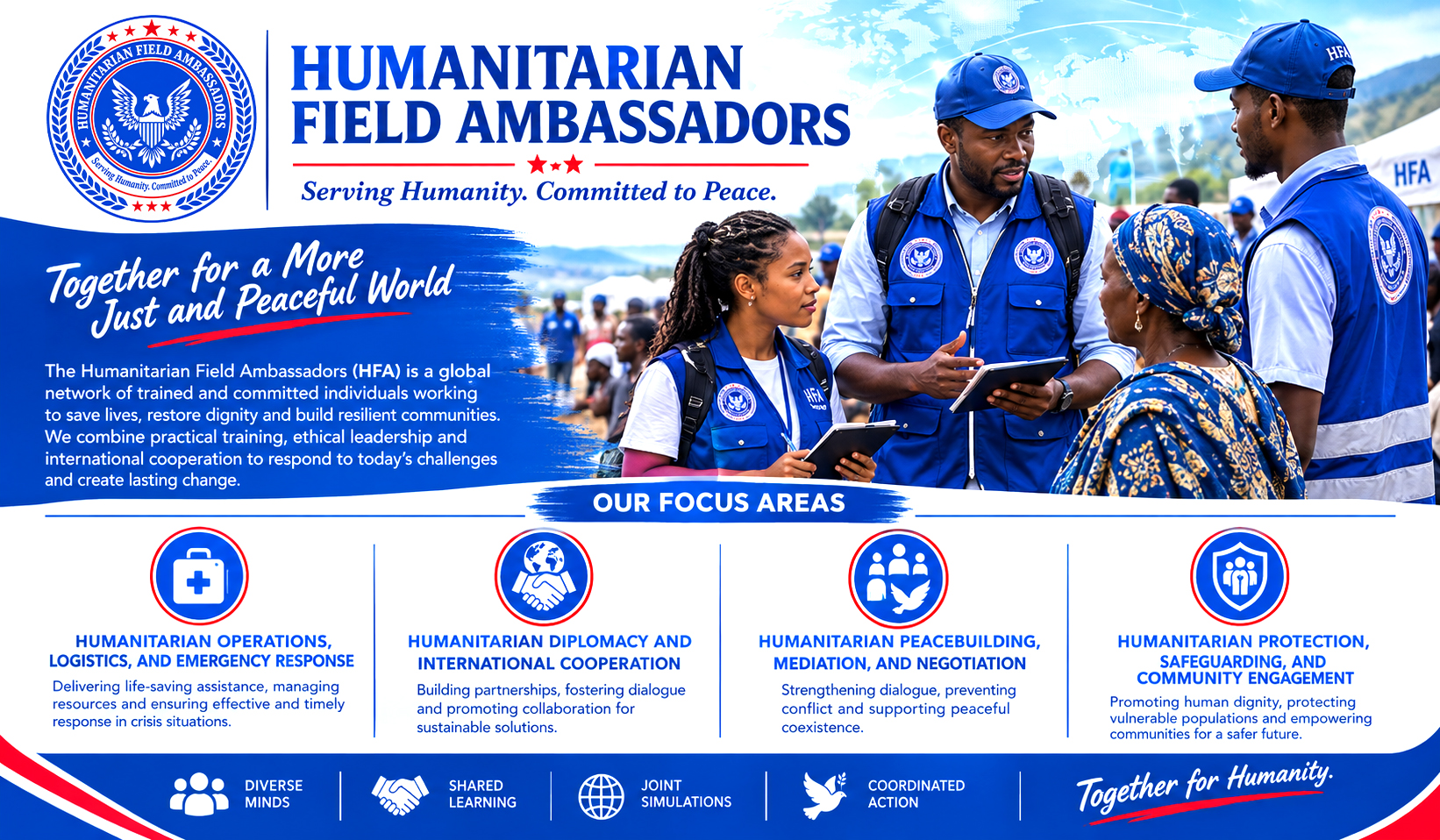
Humanitarian Field Ambassadors (HFA) is a civilian, practice-oriented professional training program of GAICAM. The program prepares emerging and practicing professionals for responsible, competent, and ethical engagement in humanitarian action, peacebuilding, emergency response, civilian protection, international cooperation, and community-centered development.
HFA combines professional training with guided research, case-study analysis, independent community project development, practical simulations, and individual performance assessment. Participants are challenged to translate knowledge into practice, analyze real-world humanitarian and community challenges, develop context-appropriate responses, and demonstrate their competencies through structured practical assignments and formal evaluation.
The program is designed for individuals seeking to strengthen their practical capabilities, deepen their understanding of humanitarian and peacebuilding practice, and prepare for meaningful engagement in relevant professional, civil society, and community-based initiatives.
HFA is an intensive 10-week professional training program, not a university degree program or an academic qualification. Completion is competency-based and subject to established requirements for participation, research, project implementation, practical assessment, professional conduct, and integrity. Certification is awarded only to participants who satisfy the program’s completion standards; enrollment or attendance alone does not guarantee certification.
OUR MISSION
To equip emerging and practicing professionals with the knowledge, practical competencies, ethical judgement, research skills, and applied experience required for responsible engagement in humanitarian action, peacebuilding, and community-centered initiatives.
OUR VISION
To contribute to a community of ethical, competent, and practice-ready professionals advancing humanitarian action, human dignity, peace, and sustainable community development.
CORE VALUES of HFA
Human Dignity and Respect for Rights. Upholding the dignity, rights, safety, and agency of every person and community, without discrimination. Integrity and Accountability. Maintaining honesty, professional responsibility, transparency, and accountability in decisions, conduct, research, and program participation. Impartiality and Inclusion. Promoting fair, needs-based engagement and respect for diversity, without discrimination based on identity, background, or circumstance.
Civilian and Non-Partisan Practice. Maintaining a civilian, non-military, and politically non-partisan approach to humanitarian engagement, peacebuilding, and community service.
Evidence and Professional Judgement. Using credible information, contextual analysis, critical thinking, and sound judgment to inform decisions and practical responses.
Community Participation and Local Ownership. Respecting community knowledge, encouraging meaningful participation and supporting locally informed, context-sensitive solutions.
Safeguarding and Do No Harm. Prioritizing safety, confidentiality, informed participation, and the prevention of harm, exploitation, abuse, and avoidable risks.
Professional Excellence and Continuous Learning. Encouraging disciplined practice, constructive feedback, reflective learning, and continuous improvement.
Fairness and Transparency in Assessment. Applying clear requirements, consistent assessment standards, and accountable procedures for evaluating performance and determining certification.
WHY BECOME A HUMANITARIAN FIELD AMBASSADOR?
Develop Skills That Matter in the Real World: Build a stronger understanding of humanitarian principles, peacebuilding, protection, safeguarding, and responsible professional practice. Learn to examine complex situations, identify challenges, consider available evidence, and develop realistic responses grounded in sound judgement. HFA is designed to help you understand not only what humanitarian and community-focused work involves, but also the responsibilities that come with it.
Learn by Doing, Not Just by Listening: HFA places practical application at the center of the learning experience. Through guided research, case-study analysis, an independent community project, and practical simulations, you will have opportunities to apply your learning to defined humanitarian and community challenges. The program encourages you to move beyond understanding concepts to demonstrating how they can inform responsible action.
Discover How to Research Problems and Develop Solutions: Meaningful action begins with understanding the problem. Develop your ability to formulate practical research questions, undertake structured and ethical field inquiry, analyze findings, and use credible evidence to support recommendations. You will also develop an independent community project designed to address an identified need, with attention to objectives, activities, resources, risks, and responsible implementation.
Strengthen Your Professional Confidence: Learn to communicate ideas clearly, present findings, engage respectfully with communities and institutional stakeholders, and contribute constructively to collaborative work. Through research presentations, report defence, practical assignments, and professional interaction, you will develop the ability to explain your decisions, justify your recommendations, and respond thoughtfully to questions.
Explore a Specialization Aligned with Your Aspirations: HFA offers four professional training specializations, allowing you to focus on the area that best reflects your interests and development goals. Through Humanitarian Diplomacy and International Cooperation, you will explore dialogue, stakeholder engagement, humanitarian advocacy, and cooperation. Through Humanitarian Peacebuilding, Mediation and Negotiation, you will develop your understanding of conflict analysis, constructive dialogue, and peaceful approaches to addressing disputes. Through Humanitarian Operations and Emergency Response, you will examine response planning, coordination, logistics, and operational decision-making in civilian humanitarian settings. Through Humanitarian Protection, Safeguarding and Community Engagement, you will strengthen your understanding of human dignity, safeguarding, ethical engagement, inclusion, and responsible approaches to protecting people at risk.
Whichever specialization you choose, you will work towards a common standard of professional integrity, ethical conduct, accountability, and respect for human dignity. Each track combines relevant learning with an applied assignment designed to help you demonstrate your understanding of the selected field.
Put Your Learning to the Test: HFA is designed to help participants demonstrate what they can do, not simply what they have heard. The program culminates in a mandatory five-day practical intensive that includes simulations, practical evaluation, and the presentation and defense of individual professional reports before an assessment panel. This process challenges you to apply your learning, explain your reasoning, respond to questions, and demonstrate your readiness to approach professional and community challenges responsibly.
Build a Foundation for Responsible Service: Humanitarian and community-focused work carries significant responsibilities. HFA emphasizes safeguarding awareness, confidentiality, responsible use of information, professional accountability, and recognition of the limits of individual competence. You will be encouraged to approach communities with respect, acknowledge local knowledge, consider potential risks, and understand why good intentions must be accompanied by ethical conduct and responsible practice. The programme also emphasizes the importance of knowing when to seek specialist assistance or refer a concern through appropriate channels.
Earn Recognition Through Demonstrated Achievement: Participants who complete all mandatory requirements and meet the applicable assessment standards may receive a Humanitarian Field Ambassadors program certificate identifying their completed training specialization. The certificate recognizes successful completion of the program’s professional training and assessment requirements; it is not awarded on attendance alone. HFA is a professional training program, not an academic degree program, and its certificate should not be interpreted as a professional license, diplomatic status, or automatic authorization to undertake specialized duties.
Is HFA Right for You?
HFA may be right for you if you are a student, graduate, volunteer, community leader, NGO or civil-society practitioner, development professional, humanitarian worker, peacebuilding practitioner, or another individual seeking to strengthen relevant professional capabilities. It is particularly suited to people who are willing to learn through practical assignments, engage responsibly with community challenges, undertake independent work, and demonstrate their learning through assessment.
You do not need to claim to have all the answers before you begin. You do need a genuine commitment to learning, integrity, respect for human dignity, and responsible service.
Before applying, ensure that you can commit to the full 10-week programme, complete all mandatory assignments, undertake the required research and community project, present and defend your individual professional report, and attend all five days of the final in-person practical intensive.
More about Humanitarian Field Ambassadors
PROFESSIONAL TRAINING TRACKS
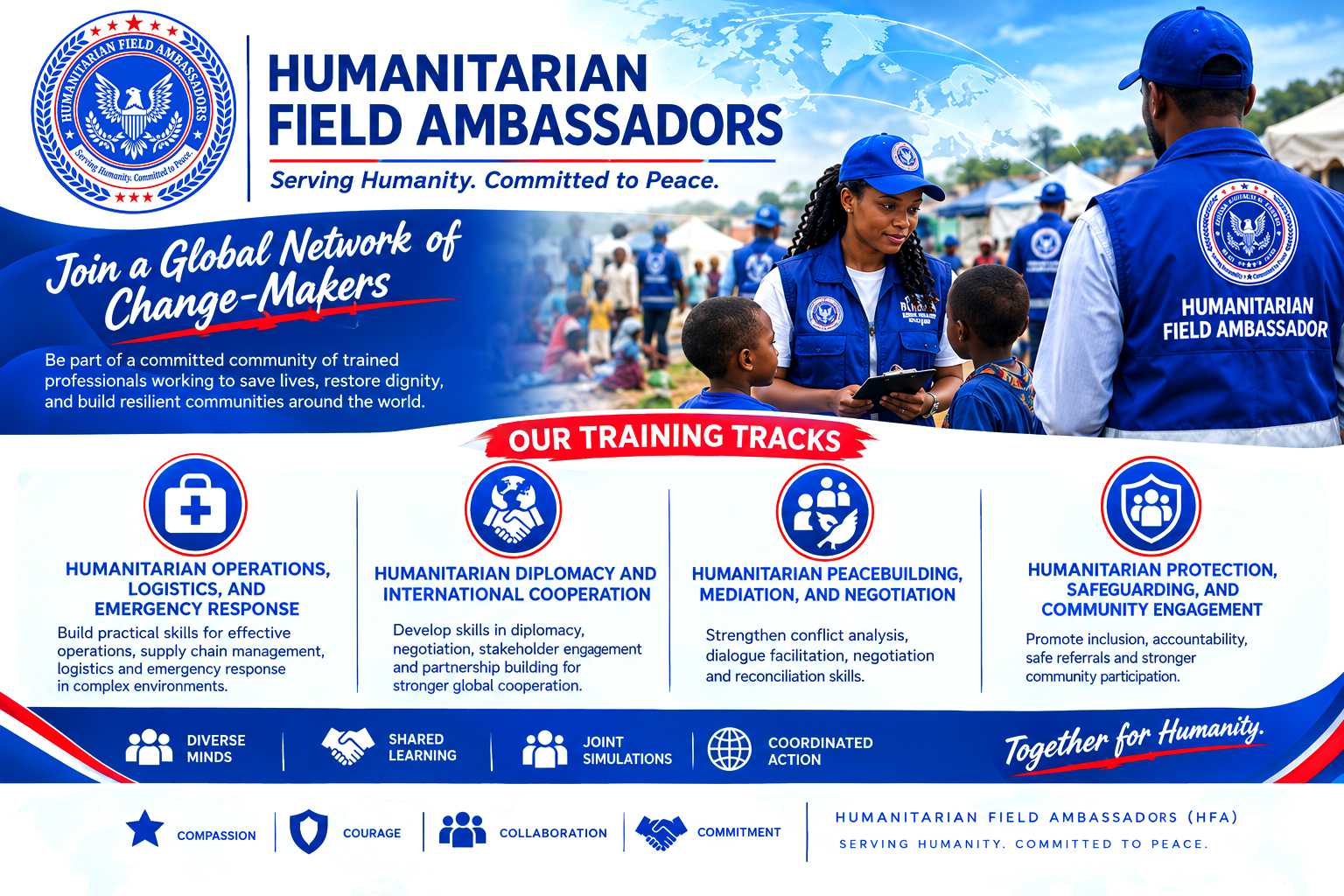
The Humanitarian Field Ambassadors (HFA) program offers four professional training tracks, enabling participants to specialize in an area of humanitarian practice aligned with their interests, experience, and professional aspirations. Each participant must select one approved training specialization.
Although participants follow different specializations, all are subject to the same program-wide requirements, including guided research, case-study analysis, an independent community project, practical simulations, submission and review of required work, final assessment, and individual presentation and defense before an assessment panel.
Each track combines relevant professional knowledge with applied learning and an individual track-specific assignment. Participants are expected not only to understand their chosen subject area but also to analyze practical challenges, develop context-appropriate responses, and uphold the ethical standards governing responsible humanitarian and community engagement.
TRACK 1 - Humanitarian Operations, Logistics, and Emergency Response
Graduate Designation: Humanitarian Field Ambassador
Training Specialization: Humanitarian Operations and Emergency Response
Designed for: NGO and community volunteers, project and operations personnel, graduates, humanitarian program assistants, and individuals seeking practical foundations in humanitarian preparedness, coordination, and response support.
Core Learning Areas: Basic humanitarian needs assessment; operational planning and coordination; team roles and responsibilities; logistics and inventory documentation; transport and distribution planning; emergency preparedness; situation reporting; accountability to affected communities; scenario-based response planning; basic first-aid awareness; and appropriate referral procedures.
Applied Track Assignment: Participants will prepare and defend a humanitarian operational response plan, supported by a logistics checklist and situation report, based on an approved humanitarian case study or simulated emergency. The assignment must demonstrate an understanding of response priorities, available resources, coordination arrangements, operational risks, and accountability to affected communities.
Professional Scope and Safety: The Humanitarian Field Ambassadors program prepares participants to contribute responsibly to humanitarian action within the limits of their training, competence, and assigned responsibilities. HFA training does not, by itself, qualify participants to provide clinical care, conduct technical rescue operations, enter hazardous areas without appropriate safety measures and authorization, or perform duties requiring additional specialist qualifications, licenses, or official approval. Participants are expected to recognize the limits of their competence, follow applicable safety and safeguarding procedures, and refer specialized tasks to appropriately qualified and authorized professionals.
TRACK 2 - Humanitarian Diplomacy and International Cooperation
Graduate Designation: Humanitarian Field Ambassador
Training Specialization: Humanitarian Diplomacy and International Cooperation
Designed for: Students and graduates of international relations, emerging policy professionals, NGO personnel, advocates, partnership officers, and individuals interested in humanitarian diplomacy, institutional engagement, and international cooperation.
Core Learning Areas: The international humanitarian system and institutional architecture; humanitarian diplomacy and principled advocacy; stakeholder mapping and analysis; diplomatic protocol and intercultural communication; partnership development and coordination; professional correspondence; and the preparation of briefing notes, policy briefs, and institutional presentations.
Applied Track Assignment: Participants will develop and defend a stakeholder analysis, policy briefing, or partnership proposal addressing an approved humanitarian or community challenge. The assignment must demonstrate contextual understanding, evidence-informed analysis, clear recommendations, and an appropriate approach to stakeholder engagement.
Professional Scope and Safety: Completion of this track does not confer diplomatic status, diplomatic immunity, or authority to represent any government, the United Nations, or another institution. Any institutional representation must be separately and formally authorized by the relevant organization.
TRACK 3 - Humanitarian Protection, Safeguarding, and Community Engagement
Graduate Designation: Humanitarian Field Ambassador (Protection and Community Engagement)
Training Specialization: Humanitarian Protection, Safeguarding, and Community Engagement
Designed for: NGO personnel and leaders, teachers, community workers, volunteers, social-service personnel, development practitioners, and individuals involved in community-based programs or services for people at risk.
Core Learning Areas: Humanitarian protection principles; safeguarding frameworks and responsibilities; prevention of sexual exploitation and abuse; safe and appropriate engagement with children and adults at risk; informed consent and professional boundaries; inclusion and accessibility; meaningful community participation; feedback and complaints mechanisms; safe referral pathways; confidentiality and information protection; and the relationship between humanitarian action and longer-term development.
Applied Track Assignment: Participants will conduct and defend a safeguarding and inclusion review of an approved or illustrative community project. The review must identify potential protection and safeguarding risks and propose practical measures to strengthen safety, accessibility, accountability, confidentiality, and meaningful community participation.
Professional Scope and Safety: Completion of this track does not, by itself, authorize participants to investigate allegations of abuse, conduct specialist protection assessments, provide professional case management or clinical support, or deliver other specialized services beyond their qualifications, competence, and authority. Concerns must be handled sensitively and referred through safe, established reporting and referral mechanisms, in accordance with applicable safeguarding procedures, confidentiality requirements, and legal obligations. Participants are expected to respect the dignity, rights, choices, and safety of affected individuals and avoid actions that could expose them to further harm.
TRACK 4 - Humanitarian Peacebuilding, Mediation, and Negotiation
Graduate Designation: Humanitarian Field Ambassador (Peace and Mediation)
Training Specialization: Humanitarian Peacebuilding, Mediation, and Negotiation
Designed for: Youth and community leaders, civil-society practitioners, educators, facilitators, NGO personnel, and individuals working with diverse communities, supporting social cohesion, or operating in conflict-sensitive environments.
Core Learning Areas: Conflict analysis and conflict sensitivity; principles and approaches to humanitarian peacebuilding; dialogue, facilitation, and negotiation techniques; foundations of mediation; social cohesion and community reconciliation; community participation, feedback, and engagement; conflict prevention and early-warning awareness; ethical documentation and information handling; and appropriate referral pathways.
Applied Track Assignment: Participants will develop and defend a conflict-sensitive community engagement or peacebuilding plan, or analyze an approved dialogue or conflict-related case and present practical, evidence-informed recommendations. The assignment must demonstrate an understanding of the context, relevant stakeholders, conflict dynamics, potential risks, ethical considerations, and feasible approaches to dialogue, conflict prevention, or social cohesion.
Professional Scope and Safety: Completion of this track does not, by itself, confer professional accreditation or licensing as a mediator, nor does it authorize participants to undertake legal practice, specialist psychosocial interventions, protection case management, or other professional services for which they are not qualified or authorized. Participants are expected to work within their demonstrated competence, respect confidentiality and informed consent, remain impartial where appropriate to their assigned role, recognize potential risks, and refer complex or high-risk cases through appropriate professional or institutional channels.
PROGRAM STRUCTURE
The Humanitarian Field Ambassadors (HFA) program follows a structured, 10-week professional learning journey designed to move participants from foundational learning to practical application, community-based project development, professional evaluation, and demonstrated competence. The program combines online instruction, guided self-study, case-study analysis, community needs identification, field engagement, development and implementation of an Integrated Community Project, written documentation, structured feedback, individual revision, and a final five-day in-person practical intensive.
Each stage builds on the preceding one, allowing participants to apply what they learn, improve their work through feedback, and prepare for the final assessment. The schedule is intensive and milestone-driven. Participants are expected to manage their time responsibly, follow approved project procedures, meet submission deadlines, and maintain the required standards of professional conduct, integrity, and safeguarding.
The following outline explains what participants should expect during each stage of the program before deciding to apply. Exact dates, session times, submission templates, assessment rubrics, fieldwork guidance, and panel schedules will be communicated to each cohort before the program begins.
Week 1: Online Training I – Orientation and Shared Foundations
The program begins with an online training session covering orientation, the selected Training Specialisation, humanitarian principles, professional conduct, safeguarding, case-study analysis, and expectations for the Integrated Community Project. Participants are introduced to responsible field engagement, informed consent, appropriate documentation, and the ethical considerations involved in working with communities. At this stage, they receive the self-study materials and project proposal template needed to begin developing their independent work.
Weeks 1–2: Guided Self-Study and Community Project Approval
During the first two weeks, participants undertake guided independent learning, preliminary case-study analysis, and exploration of relevant community challenges. They identify a local or community need, begin understanding its context and key stakeholders, and develop an Integrated Community Project proposal.
The proposed project must be presented for review and formally approved by the end of Week 2 before participants proceed with the associated field engagement and implementation activities. This approval process helps ensure that each project is relevant, feasible, appropriately scoped, and consistent with applicable ethical, professional, and safeguarding requirements.
Weeks 3–6: Field Engagement and Integrated Community Project Development
From Weeks 3 to 6, participants undertake approved field engagement, interact respectfully with relevant community members and stakeholders, and document appropriate observations and supporting evidence. Each participant develops and undertakes an Integrated Community Project addressing an identified community need relevant to their chosen Training Specialisation.
The project should demonstrate the participant’s ability to understand a community challenge, develop a feasible response, apply relevant professional principles, document activities and progress, and identify practical lessons and recommendations. Participants prepare an Integrated Community Project Report documenting the context, objectives, approach, activities undertaken, outcomes or progress, challenges, lessons learned, and recommendations.
The Integrated Community Project and its accompanying report constitute one integrated body of work, rather than separate assignments. Draft project reports and supporting documentation must be submitted by the end of Week 6.
Week 7: Review, Corrections, and Final Submission
Week 7 is dedicated to reviewing draft submissions and addressing feedback. Participants receive structured comments on their Integrated Community Projects and are expected to correct identified gaps relating to evidence, relevance, feasibility, implementation, documentation, safeguarding, and presentation.
Participants then submit their revised final Integrated Community Project Reports and supporting project documentation by the prescribed deadline. This stage gives participants an opportunity to strengthen the quality, clarity, and practical value of their work before the final intensive.
Week 8: Online Training II – Professional Consolidation
The second online training session consolidates learning within each participant’s selected Training Specialisation. It addresses relevant professional practice, project management and accountability, professional communication, project documentation and presentation, and practical decision-making.
Participants also receive guidance on preparing for their Integrated Community Project presentation and oral defense, together with a briefing on the final intensive assessment procedures and applicable evaluation criteria. The aim is to ensure that participants can explain their project decisions, demonstrate what they have learned, and respond confidently and responsibly to questions from the assessment panel.
Week 9: Individual Revision and Final Readiness
Week 9 is reserved for independent revision and preparation for the final assessment. Participants review program content using the revision materials, assess their own readiness, and prepare for the practical evaluation and presentation and oral defense of their Integrated Community Projects.
Individual consultations may be offered where available. Participants also make the necessary travel and documentation arrangements and receive readiness information and the scheduled assessment panel timetable.
Week 10: Final Five-Day In-Person Practical Intensive
The tenth week culminates in a mandatory five-day in-person practical intensive. This is an essential part of the program and provides participants with the opportunity to demonstrate their learning through practical exercises, simulations, professional evaluation, and the presentation and oral defense of their Integrated Community Projects.
Days 1–2: Practical Training and Simulations
Participants undertake in-person practical training and scenario-based simulation exercises relevant to their Training Specialisation. These activities are designed to assess their ability to apply knowledge, exercise sound judgement, work responsibly, and respond appropriately to defined professional or community challenges.
Days 3–4: Practical Evaluation and Integrated Community Project Presentation and Oral Defense
Participants undergo practical evaluation and present and defend their Integrated Community Projects before a designated assessment panel. They are expected to explain the community need addressed, the rationale for their chosen approach, the activities undertaken, the outcomes or progress achieved, the challenges encountered, and the recommendations arising from their experience.
Participants must respond to questions from the panel and demonstrate an understanding of the professional, ethical, and safeguarding considerations relevant to their work. The assessment considers both the quality of the project and the participant’s ability to explain and defend their decisions and demonstrate practical competence.
Day 5: Assessment Moderation and Graduation Activities
The program concludes with assessment moderation, verification of completion requirements, and certification decisions. Graduation activities are scheduled in accordance with program procedures and subject to participants meeting the applicable requirements. Attendance at the final intensive, by itself, does not guarantee certification.
Your Commitment as a Participant
The HFA program requires sustained participation, independent effort, and responsible community engagement throughout the full 10 weeks. Before enrolling, prospective participants should be prepared to attend the online training sessions, complete guided self-study and case-study assignments, obtain approval for their Integrated Community Project before undertaking the associated field activities, carry out their projects, submit and revise their project reports, and participate in the final practical intensive.
All mandatory program components must be completed, and participants must meet the applicable assessment standards to qualify for certification. Prospective participants should therefore consider their availability, personal responsibilities, project commitments, and ability to attend all five days of the final in-person intensive before submitting an application.
The HFA program is a professional training program focused on practical competence and responsible service. Successful completion depends not on attendance alone, but on demonstrated learning, the quality of the Integrated Community Project, satisfactory performance in practical evaluation, successful presentation and oral defense, and compliance with the program’s professional and ethical requirements.