

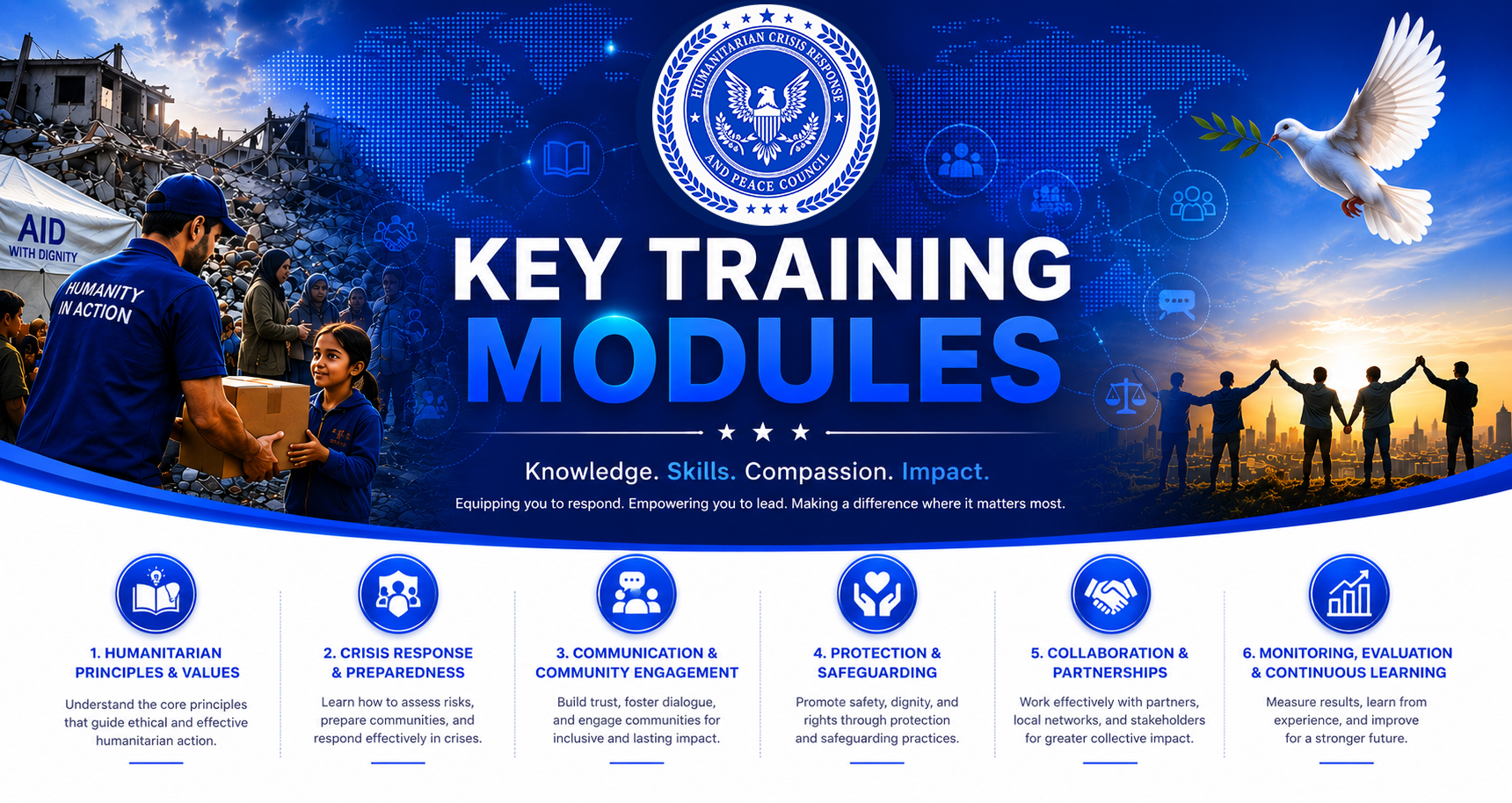
Key Training Modules
WHAT YOU WILL LEARN AND GAIN FROM THE HUMANITARIAN FIELD AMBASSADORS (HFA) PROGRAMME
Serving Humanity. Committed to Peace.
The Humanitarian Field Ambassadors (HFA) program is a civilian, practice-oriented professional training program of the Go Africa Initiative for Community Action and Mobilization (GAICAM). It is designed to equip emerging and practicing professionals with practical knowledge, applied skills, professional judgment, and community-centered experience relevant to humanitarian action, peacebuilding, emergency response, international cooperation, protection, and sustainable community development.
Through guided learning, case-study analysis, an Integrated Community Project, professional specialization, scenario-based simulations, and practical assessment, participants develop the competencies needed to understand humanitarian challenges, contribute responsibly to community initiatives, and strengthen their readiness for humanitarian and development-related work.
HFA combines foundational humanitarian learning with specialized professional development and practical application. Its ten-week training journey culminates in a mandatory five-day in-person practical intensive, during which participants undertake practical exercises and simulations and present and defend their Integrated Community Project before an assessment panel.
1. Core Humanitarian Knowledge and Professional Competencies
Build a strong understanding of humanitarian principles, responsible practice, and the professional standards that guide humanitarian and community-centered action.
Humanitarian Principles and Professional Conduct
Understand the fundamental principles of humanitarian action, including humanity, impartiality, neutrality, and independence, alongside accountability, integrity, ethical decision-making, and responsible engagement with affected communities.
Humanitarian Crisis Response and Preparedness
Develop an understanding of humanitarian emergencies, crisis preparedness, response coordination, community needs identification, risk awareness, and the principles that guide effective and responsible humanitarian action.
Conflict Sensitivity, Peacebuilding, and Mediation
Explore the causes and effects of conflict, conflict-sensitive approaches, dialogue, negotiation, mediation and community-based peacebuilding. Develop practical approaches to managing disagreements constructively and supporting peaceful coexistence.
Protection, Safeguarding, and Community Engagement
Learn how to recognize protection concerns, respect dignity and rights, identify safeguarding risks, maintain appropriate professional boundaries, and engage responsibly with children, vulnerable individuals, and affected communities.
Emergency Preparedness and Basic First-Aid Awareness
Develop awareness of personal safety, emergency preparedness, appropriate referral, and the role of first aid in humanitarian settings. Any practical first-aid competencies will depend on the training delivered and the assessment undertaken; HFA completion should not be represented as a substitute for a recognized first-aid qualification unless such qualification is separately established.
2. Professional and Applied Humanitarian Skills
Develop practical competencies that can support responsible participation in humanitarian, peacebuilding, community development and international cooperation initiatives.
Humanitarian Operations and Coordination
Understand the planning and coordination of humanitarian activities, community-level response, resource management, operational communication, and collaboration among relevant stakeholders.
Community Needs Identification and Project Management
Learn to identify community needs, define problems, establish objectives, plan activities, identify resources, monitor progress, and document outcomes. Apply these principles through the development and implementation—or documented progress—of an Integrated Community Project.
Humanitarian Diplomacy and International Cooperation
Explore stakeholder engagement, humanitarian advocacy, institutional communication, partnership development, negotiation, and cooperation among public institutions, civil society organizations, humanitarian actors, and development partners.
Psychosocial Awareness and Responsible Referral
Develop an understanding of the emotional and social effects of crises, supportive communication, psychological first aid principles where included in the training, and the importance of referral to appropriately qualified professionals. Participants are not qualified as mental health practitioners simply by completing HFA.
Digital Responsibility, Information Management, and Communication
Strengthen skills in responsible information handling, digital communication, data protection, documentation, and the ethical use of information in humanitarian and community-based work. Where included in the relevant learning activities, participants may also explore digital tools for coordination and information management.
Humanitarian Reporting and Project Documentation
Learn to prepare clear, structured, and professional documentation of community needs, project activities, implementation progress, challenges, outcomes, lessons learned, and recommendations. These skills support transparent communication, accountability, and informed decision-making.
Climate Awareness and Disaster Risk Reduction
Understand the relationship between environmental pressures, climate-related hazards, community vulnerability, and humanitarian needs. Explore practical approaches to risk awareness, preparedness, resilience, and community-level disaster risk reduction.
3. Training Specializations
HFA offers four professional Training Specialisations, enabling participants to develop a focused understanding of a selected area of humanitarian and community-centered practice.
1. Humanitarian Diplomacy and International Cooperation
Focus on humanitarian advocacy, stakeholder engagement, negotiation, institutional relations, partnership development and cooperation in humanitarian and international development settings.
2. Humanitarian Peacebuilding, Mediation, and Negotiation
Focus on conflict analysis, dialogue facilitation, negotiation principles, mediation approaches, conflict sensitivity, reconciliation, and community-based peacebuilding.
3. Humanitarian Operations and Emergency Response
Focus on humanitarian preparedness, operational planning, response coordination, community needs identification, logistics awareness, risk management, and responsible emergency response.
4. Humanitarian Protection, Safeguarding, and Community Engagement
Focus on protection principles, safeguarding, ethical community engagement, accountability, inclusion, dignity, responsible referrals, and the prevention of harm.
The selected Training Specialisation provides direction for relevant learning activities and professional development. It does not, by itself, confer a regulated professional license or authorization to perform duties reserved for appropriately qualified or authorized personnel.
4. Integrated Community Project: Applying Your Learning
A central component of HFA is the Integrated Community Project (ICP). This requirement enables participants to apply program learning to a defined community need or practical humanitarian or development concern.
Under the program guidance, participants develop their project proposals and obtain approval before commencing the relevant field activities. They then undertake field engagement and project implementation—or document meaningful progress where full implementation is not feasible within the program period.
The Integrated Community Project brings together:
- Community needs identification and problem definition.
- Project planning, objectives, and proposed activities.
- Responsible field engagement and implementation or documented progress.
- Monitoring, supporting documentation, and outcome assessment.
- Challenges, lessons learned, and practical recommendations.
- Preparation of an Integrated Community Project Report.
- Presentation and oral defense of the project before an assessment panel.
The project is not merely a written assignment. It is an opportunity to demonstrate the ability to connect professional learning with responsible community engagement, practical planning, documentation, reflection, and accountability.
5. Practical Simulation and Professional Evaluation
HFA includes a mandatory five-day in-person practical intensive designed to consolidate learning and evaluate participants’ application of program competencies.
During the intensive, participants engage in practical training, scenario-based simulations, and other relevant exercises aligned with the program’s objectives and Training Specializations. These activities are intended to strengthen decision-making, teamwork, communication, problem-solving, professional conduct and the ability to respond thoughtfully to realistic humanitarian and community-based scenarios.
Participants also present and defend their Integrated Community Projects before an assessment panel. This process enables them to explain their approach, demonstrate their understanding, discuss the project’s progress and outcomes, respond to questions, and reflect on challenges and lessons learned.
Successful completion depends on meeting the approved assessment standards and fulfilling all mandatory requirements. Attendance alone does not guarantee certification.
6. Professional Development and Humanitarian Career Readiness
HFA supports participants in developing a stronger professional foundation for future engagement in humanitarian action, peacebuilding, community development, emergency preparedness, and international cooperation.
The program helps participants strengthen their ability to:
- Present their skills, training, and practical experience professionally.
- Document community-based activities and project outcomes.
- Communicate effectively with community members and relevant stakeholders.
- Work collaboratively and exercise responsible professional judgement.
- Understand ethical responsibilities, safeguarding and accountability.
- Identify potential pathways for further learning, volunteering and professional engagement.
- Apply their competencies in relevant roles, subject to the requirements of employers, organisations and applicable professional standards.
HFA is intended to strengthen professional readiness; it does not guarantee employment, deployment, admission to another programme, funding or engagement by any humanitarian organisation.
7. What You Receive Upon Successful Completion
Participants who fulfil all mandatory programme requirements and meet the approved assessment standards may receive the following completion package:
Training and assessment documentation
- A GAICAM-issued HFA Training Completion Certificate, with digital verification through GAICAM’s official verification system.
- An individual Training Evaluation Report documenting assessment outcomes.
Programme identification and branded materials
- HFA Participant Identification Card.
- HFA-branded lanyard.
- HFA Branded Field Cap.
- HFA Branded Field Vest.
- Training Designation Badge.
- Training Specialisation Badge.
- HFA Training Completion Pin.
- HFA Handbook.
- Official HFA Blue Trousers.
- HFA Necktie.
- HFA White Shirt.
The identification card and branded materials are for programme-related identification and use. They do not confer diplomatic status, military or security authority, government or international organisational affiliation, or automatic authorisation to undertake humanitarian missions.
The certificate confirms successful completion of GAICAM’s professional training programme. It is not a university degree or an externally accredited academic qualification unless a separate, verifiable accreditation arrangement is formally established.
8. Your Expected Training Outcomes
By the end of the HFA programme, successful participants are expected to demonstrate an improved ability to:
- Understand humanitarian principles, professional conduct, safeguarding and the responsibilities associated with community-centred humanitarian practice.
- Apply relevant concepts and practical skills to humanitarian, peacebuilding, protection, emergency-response or international cooperation scenarios aligned with their Training Specialisation.
- Plan and document an Integrated Community Project addressing a defined community need or practical concern.
- Demonstrate problem-solving, communication, teamwork, ethical judgement and responsible decision-making during practical exercises and simulations.
- Present and defend their Integrated Community Project and respond constructively to assessment-panel questions.
- Evaluate project progress, identify challenges, explain lessons learned and propose practical recommendations.
- Demonstrate professional readiness for appropriate future opportunities in humanitarian and community-centred work, subject to the requirements of the relevant organisations and roles.
Begin Your HFA Journey
The Humanitarian Field Ambassadors programme offers a structured opportunity to develop practical competencies, deepen professional understanding, and connect learning with responsible community engagement.
Learn with purpose. Practise with integrity. Serve humanity.
Humanitarian Field Ambassadors (HFA) — Serving Humanity. Committed to Peace.
