

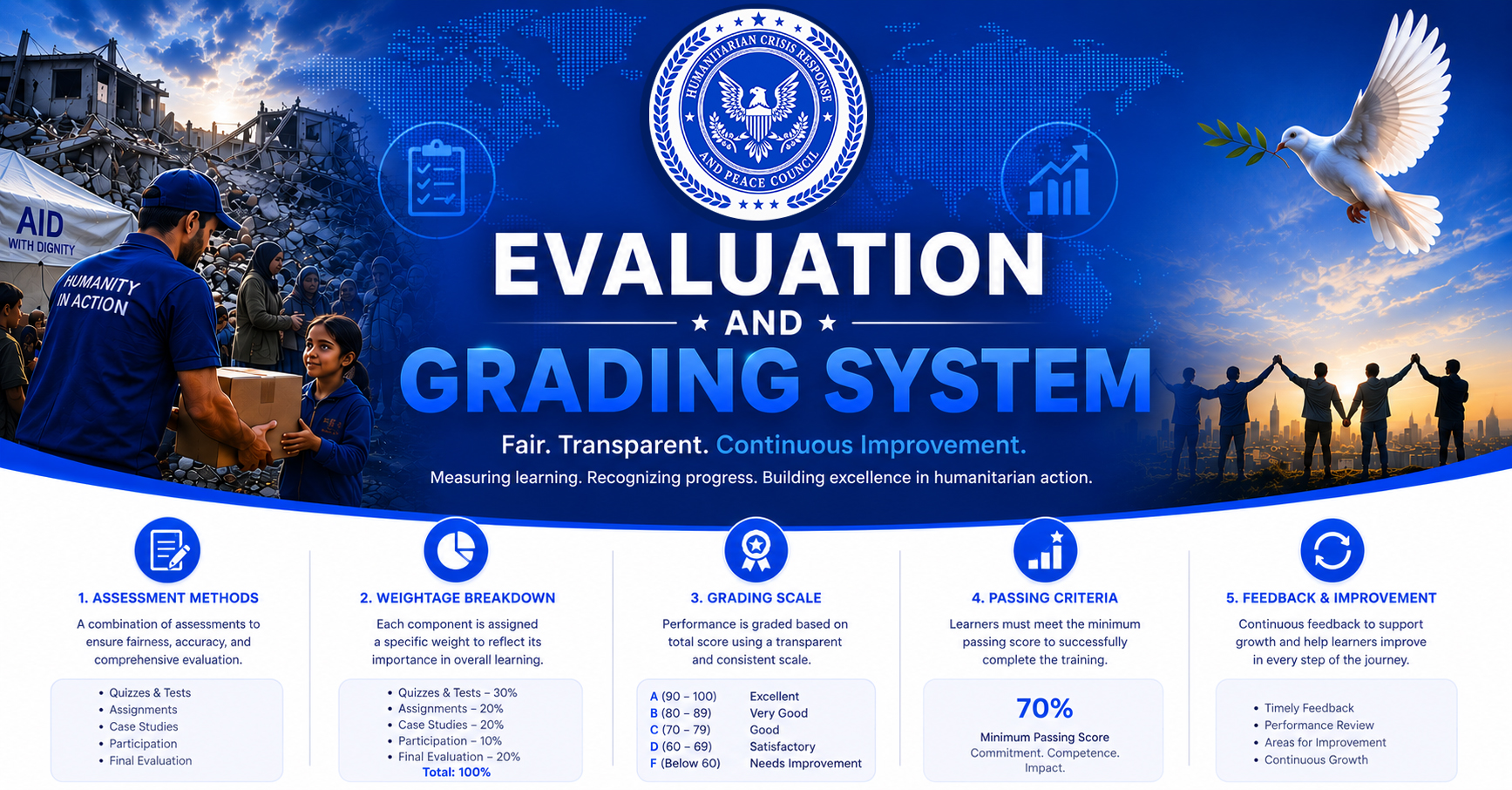
Evaluation and Grading System
HFA ASSESSMENT FRAMEWORK
The Humanitarian Field Ambassadors (HFA) program uses a practical, competency-based assessment framework designed to evaluate participants’ understanding, professional development, community engagement, practical performance, and ability to apply the knowledge and skills acquired during the program.
Assessment focuses on each participant’s ability to identify a relevant community need, develop and implement an appropriate response, document activities and outcomes, demonstrate professional competence, and explain and defend the decisions and recommendations arising from the Integrated Community Project.
1. Assessment Components and Weighting
| Assessment Component | Weight |
|---|---|
| Self-study, case-study analysis, and Training Specialisation assignments | 15% |
| Integrated Community Project, including needs identification, field engagement, project development and implementation, documentation, outcomes, and supporting evidence | 40% |
| Practical training and general evaluation during the five-day intensive | 15% |
| Presentation and oral defense of the Integrated Community Project | 25% |
| Professional conduct and participation | 5% |
| TOTAL | 100% |
2. The Integrated Community Project
The Integrated Community Project is a central requirement of the HFA program. It brings together practical field engagement, community needs identification, project planning, implementation or documented progress, monitoring, lessons learned, and recommendations within one coherent body of work.
Each participant must complete an approved project relevant to their chosen Training Specialisation. The project must demonstrate a clear understanding of the community need being addressed, an appropriate and feasible response, responsible engagement with community members and stakeholders, and evidence of the activities undertaken and results or progress achieved.
Participants are required to submit an Integrated Community Project Report documenting the community context, project objectives, approach, activities undertaken, outcomes or progress, challenges, lessons learned, and practical recommendations. The report must be presented and defended before the designated assessment panel.
The Integrated Community Project is one integrated requirement, not two separate projects. Its development, implementation, and supporting documentation account for 40% of the final grade, while the presentation and oral defense are assessed separately at 25%.
3. Proposed Grading Scale
| Grade | Score | Performance Classification |
|---|---|---|
| A | 80–100% | Excellent |
| B | 70–79% | Very Good |
| C | 60–69% | Competent |
| D | 50–59% | Below Programme Standard |
| E | Below 50% | Fail |
The proposed minimum overall passing score is 60%, subject to formal approval by GAICAM. Achieving the minimum overall score does not automatically qualify a participant for certification if mandatory program requirements remain incomplete or serious concerns relating to integrity, safeguarding, or professional conduct have been established.
4. Mandatory Requirements for Graduation
To qualify for graduation and certification, participants must:
- Complete the required self-study, case-study analysis, and Training Specialisation assignments.
- Complete and submit the approved Integrated Community Project and its supporting documentation.
- Participate in and complete the mandatory five-day practical intensive.
- Satisfactorily complete the practical training and general evaluation requirements.
- Present and defend the Integrated Community Project before the designated assessment panel.
- Meet the program’s minimum assessment standard and comply with its professional conduct, safeguarding, and integrity requirements.
- Complete the applicable administrative verification and certification procedures.
Attendance alone does not qualify a participant for graduation or certification. All mandatory requirements must be met.
5. Certification and Verification
Successful participants may receive a GAICAM-issued Humanitarian Field Ambassadors certificate indicating the participant’s name, program title, Training Specialisation, completion date, and authorized signatories. A unique certificate reference may be included where a functioning verification system is in place.
The HFA certificate recognizes successful completion of GAICAM’s professional training program. It does not constitute an academic degree, professional license, diplomatic credential, or externally accredited qualification.
Approval note: The proposed assessment weights, grading scale, and minimum passing score must be formally reviewed and approved by GAICAM before this framework is adopted as the program’s final assessment policy.
