MUNYLEP: UNDERSTANDING THE PROGRAMME, ITS MISSION, AND ITS PLACE IN YOUTH LEADERSHIP DEVELOPMENT
MUNYLEP: UNDERSTANDING THE PROGRAMME, ITS MISSION, AND ITS PLACE IN YOUTH LEADERSHIP DEVELOPMENT
Yaoundé, Cameroon | 24 August 2026
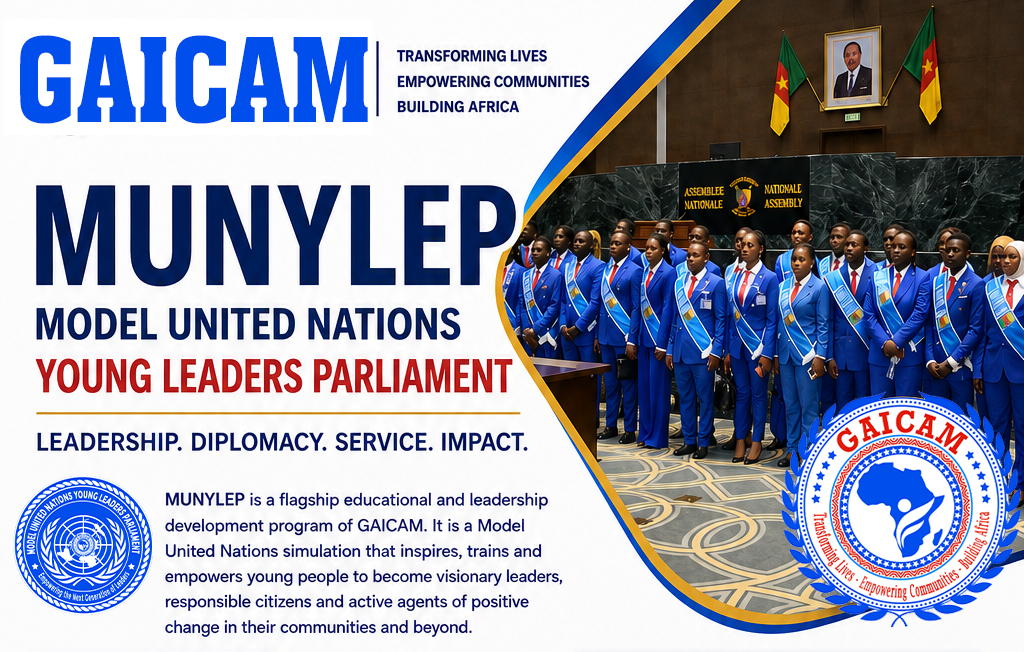
The Model United Nations Young Leaders Parliament (MUNYLEP) is a youth leadership, civic engagement, and educational simulation programme designed and administered by the Go Africa Initiative for Community Action and Mobilization (GAICAM). The programme was established to provide young people with a structured environment in which they can learn about leadership, diplomacy, multilateralism, parliamentary procedures, public speaking, negotiation, civic responsibility and community development, while gaining practical experience through structured simulations and community-oriented activities.
The name Model United Nations Young Leaders Parliament reflects the educational nature of the programme. Model United Nations, commonly known as Model UN or MUN, is an internationally established educational approach through which students and young people simulate aspects of the work of the United Nations and other multilateral institutions. Through these simulations, participants assume representative roles, study international and community issues, debate policy questions, negotiate positions and practice the procedures associated with diplomacy and multilateral decision-making. The purpose is education, skills development and leadership formation.
The United Nations itself recognizes the educational value of Model United Nations. The Organization provides resources for Model UN participants and organizers and maintains guidance designed to help simulations better understand and represent the structures, procedures and work of the United Nations. The United Nations General Assembly also adopted Resolution 77/336 on “Model United Nations” on 1 September 2023, recognizing the contribution of Model UN activities to youth engagement, international cooperation and multilateralism. MUNYLEP therefore operates within a broader international educational tradition in which young people learn about institutions and international cooperation through structured simulation.
The United Nations itself provides an important clarification regarding Model United Nations activities. In its official information concerning the Secretary-General’s message to Model UN conferences, the United Nations explains that such a message is a general message to Model UN conferences and does not constitute an endorsement by the United Nations of any particular conference or organization. The United Nations further explains that Model UN conferences are organized by schools, universities, and other organizations rather than by the United Nations itself and makes clear that there are no Model United Nations programs affiliated with the United Nations. This distinction is important: an organization may independently conduct a Model United Nations program as an educational simulation while remaining entirely separate from the United Nations as an international organization. MUNYLEP is therefore appropriately understood as an independent Model United Nations educational program administered by GAICAM.
It is important, however, to understand the distinction between a Model United Nations programme and the United Nations itself. MUNYLEP is not the United Nations, and GAICAM is not the United Nations. MUNYLEP is not an organ, agency, office, subsidiary body or official programme of the United Nations. It does not speak on behalf of the United Nations, exercise authority delegated by the United Nations, or represent itself as an official United Nations institution. Its structures, titles, parliamentary houses, activities and simulations exist within the independent educational framework established for MUNYLEP.
The word “Model” is central to this distinction. A Model United Nations programme is a simulation through which participants learn by taking on representative roles and engaging with institutional procedures. The experience may resemble aspects of diplomacy, parliamentary debate or multilateral decision-making, but participation in the simulation does not confer governmental, legislative, constitutional or diplomatic authority. A participant’s title within MUNYLEP is therefore a programme designation for educational and organizational purposes and does not constitute public office or official diplomatic representation.
MUNYLEP similarly does not replace, reproduce or exercise the functions of the Parliament of the Republic of Cameroon, the Government of Cameroon, the United Nations or any other sovereign or intergovernmental institution. Its parliamentary and diplomatic structures are educational mechanisms designed to help young people understand leadership, institutions, public policy, dialogue, negotiation and responsible civic participation.
The relationship between GAICAM and MUNYLEP is also straightforward. MUNYLEP is a programme of GAICAM. GAICAM provides the institutional framework through which the programme is developed, administered and implemented. MUNYLEP, therefore, operates as part of GAICAM’s wider commitment to youth empowerment, civic participation, leadership development and community action. The programme does not constitute a separate sovereign or governmental institution.
At the heart of MUNYLEP is the belief that young people should not merely be taught about leadership but should be given opportunities to practice leadership responsibly. The programme uses structured simulations, parliamentary exercises, policy discussions, public speaking, negotiation, community engagement and practical initiatives to help participants develop confidence, discipline, critical thinking, teamwork, communication and problem-solving abilities.
MUNYLEP’s mission extends beyond simulation. Participants are encouraged to connect what they learn with the realities of their communities. The programme promotes community activism and practical civic engagement by encouraging young leaders to identify challenges, develop initiatives, mobilize communities and contribute to solutions. In this way, MUNYLEP seeks to connect institutional learning with real-world impact.
The programme’s leadership-development objectives include strengthening public speaking and communication, developing diplomacy and negotiation skills, improving understanding of parliamentary and procedural practices, promoting critical thinking and policy analysis, encouraging civic responsibility, advancing peacebuilding and conflict-resolution skills, promoting international cooperation and developing young people who understand that leadership is ultimately measured by service and positive impact.
Since its establishment, MUNYLEP has grown into a significant youth leadership and civic-engagement platform in Cameroon. The programme has groomed more than 500 Junior Parliamentarians, supported and encouraged more than 300 grassroots community projects and initiatives, and contributed through parliamentary community activities and related initiatives that have touched more than 5,000 lives and different communities across Cameroon. These achievements reflect the programme’s commitment to moving beyond theoretical leadership education towards practical community participation and social impact.
MUNYLEP’s parliamentary model provides young people with a structured space to develop these competencies. Participants engage with parliamentary-style procedures through established parliamentary chapters and parliamentary standing committees, where participants debate issues, present positions, work collectively, undertake community-oriented activities and learn how institutions can be used to promote dialogue and responsible decision-making. The programme is therefore not simply about holding titles; it is about developing the knowledge, discipline, confidence and sense of responsibility required for meaningful leadership.
The programme also promotes a broader understanding of global citizenship. Young people increasingly operate in a world in which local challenges are connected to regional and international developments. MUNYLEP therefore encourages participants to understand global issues while remaining connected to the needs of their communities. Its approach seeks to develop young leaders who can think globally, act responsibly and contribute locally.
MUNYLEP’s use of Model United Nations principles should consequently be understood as an educational methodology, not as an institutional claim. The programme draws inspiration from international diplomacy, multilateral cooperation and the principles associated with the United Nations while maintaining its own identity, administration, structures and objectives under GAICAM.
For clarity and institutional transparency, MUNYLEP participants do not acquire governmental, legislative, judicial, constitutional or diplomatic powers through their participation in the programme. Their responsibilities and titles exist exclusively within the educational and organizational framework of MUNYLEP. They are young leaders being trained and developed through simulation and practical civic engagement, not holders of public office by virtue of their MUNYLEP membership.
GAICAM also recognizes the importance of respecting the institutional identity and protected symbols of the United Nations. MUNYLEP is therefore presented as an independent Model United Nations programme and not as a United Nations institution. The programme’s identity, communication and activities are intended to maintain a clear distinction between an educational simulation and the actual international organization.
This distinction is important not only for institutional clarity but also for the benefit of participants, parents, partners, communities and the wider public. Understanding what MUNYLEP is allows its educational objectives and achievements to be appreciated on their own merits, while understanding what MUNYLEP is not prevents confusion between a youth leadership simulation and the formal institutions of government or the United Nations system.
MUNYLEP represents GAICAM’s investment in the potential of young people. Through leadership education, structured simulation, civic participation and practical community action, the programme seeks to contribute to the development of a generation that understands leadership as responsibility, public service as a commitment and community development as a shared responsibility.
The long-term vision is to nurture young people who can participate constructively in their communities, understand national and international affairs, communicate across differences, promote peaceful solutions to challenges, and contribute to sustainable development. MUNYLEP is therefore part of a broader effort to build responsible citizens and capable young leaders who can contribute meaningfully to the future of Cameroon and Africa.
MUNYLEP is a Model United Nations programme. It is an educational simulation. It is a youth leadership and civic-engagement platform. It is a programme of GAICAM. It is not the United Nations, does not represent the United Nations and does not exercise the authority of the United Nations or any governmental institution.
Its purpose is simple and constructive: to educate, to empower, to develop leadership and to turn young people’s potential into responsible community action.
Through MUNYLEP, GAICAM remains committed to creating opportunities for young people to learn, lead, serve and contribute to the development of their communities and the wider African continent.
#TRANSFORMING LIVES.
#EMPOWERING COMMUNITIES.
#BUILDING AFRICA.
GAICAM INTERNATIONAL
Go Africa Initiative for Community Action and Mobilization
Transforming Lives • Empowering Communities • Building Africa
OFFICIAL REFERENCE MATERIAL
https://www.un.org/mun
https://www.un.org/en/node/239284
https://shop.un.org/books/united-nations-guide-model-un-23455
https://digitallibrary.un.org/record/4021176?utm_source
United Nations — How to Organize a Model UN Conference
United Nations General Assembly Resolution 77/336 — Model United Nations
United Nations — Use of the UN Name and Emblem
Republic of Cameroon — Law No. 2020/009 of 20 July 2020
#MUNYLEP #ModelUnitedNations #YoungLeaders #YouthLeadership #YouthEmpowerment #CivicEngagement #GlobalCitizenship #LeadershipDevelopment #ModelUN #Diplomacy #Multilateralism #CommunityAction #CommunityDevelopment #YouthInAfrica #AfricanYouth #ResponsibleLeadership #Peacebuilding #YouthForPeace #GAICAM #BuildingAfrica #EmpoweringCommunities #TransformingLives