

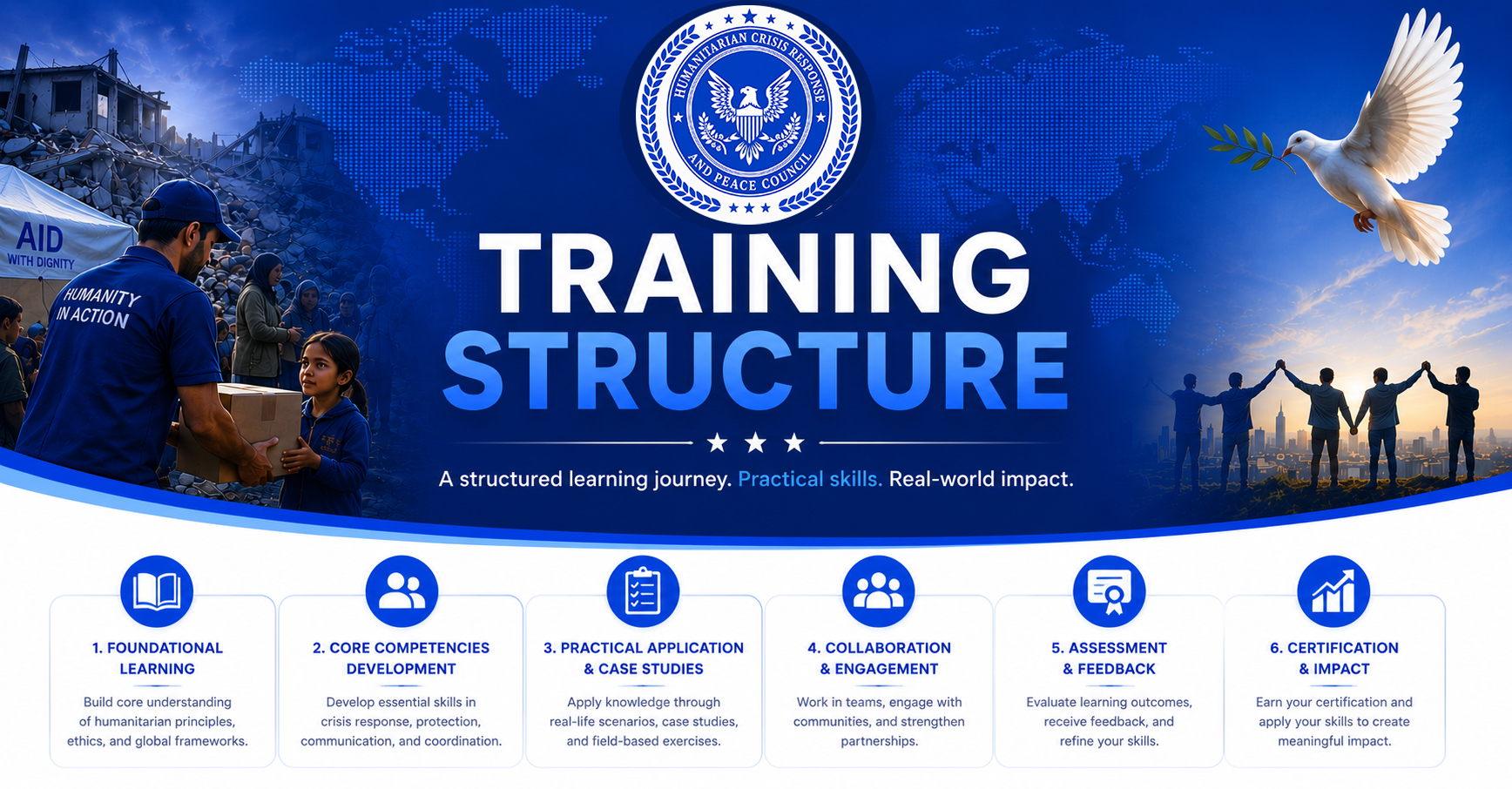
Training Structure
The Humanitarian Crisis Response & Peace Council (HCRPC) framework is an intensive, four-week, skills-first training experience. It is built entirely around muscle memory, fast decision-making, and real-world field application. By moving away from passive classroom lectures, this framework uses continuous, multi-layered simulations to turn you into a highly disciplined, capable, and confident leader ready for the field.
This structured approach ensures that you develop both the deep situational awareness and the fast operational competence required to function effectively in high-pressure humanitarian and crisis environments.
Week One: Foundation & Operational Briefing (Intensive Online Training)
Your training kicks off with a focused online phase designed to ground you in core frontline principles. Instead of memorizing textbooks, you will analyze actual emergency response maps, civilian protection guidelines, and standard field operation rules. Through guided sessions and short assignments, you will master cross-cutting modules, including humanitarian principles, emergency coordination, human rights, and professional conduct.
Your practical focus:
- Making fast, ethical decisions in chaotic crisis situations.
- Understanding how international humanitarian systems and coordination hubs work.
- Building strong communication and emergency reporting skills.
Week Two: Analysis & Scenario Building (Research & Case Studies)
During the second week, you will step into the role of a field analyst to study real-world case files of past disasters and localized conflicts. You will work on an active, track-specific problem-solving project—such as mapping out an evacuation plan, drafting an aid delivery path, or setting up a mediation outline for a community dispute. You will defend your operational plan in a structured field report. Passing this milestone is required to unlock your next phase of field training.
Your practical focus:
- Critical thinking and rapid problem-solving under pressure.
- Advanced crisis analysis and deep contextual understanding of disaster zones.
- Writing structured, professional humanitarian reports that donors respect.
Week Three: Field Application (Independent Community Drill)
Week three challenges your personal initiative through an independent, practical simulation task that you will plan, coordinate, and run directly inside your own local community. You will take the rules you have learned and execute a live drill—such as conducting a local hazard assessment, coordinating a small mock-rescue, or running a mock community dialogue session. You will document your real-time performance using basic situational reports and clear visual field proof, including photographs or video clips.
Your practical focus:
- Real-world application of your learned track skills on the ground.
- Individual initiative, leadership, and community coordination.
- Field documentation, data tracking, and visual reporting.
Week Four: High-Stress Physical Simulations & Field Graduation (Yaoundé)
The training wraps up with an intensive, high-impact in-person training week held live in Yaoundé, Cameroon. This final phase is 100% practical, outdoor, and simulation-driven, designed to mirror the chaotic reality of actual humanitarian emergencies.
During this flagship week, you will step directly into a live Humanitarian Operations Center (HOC) simulation, respond to dynamic scenario “injects” (like sudden disaster escalations or conflict outbreaks), and dive deep into advanced practical skills tailored directly to your chosen career track:
- 🚑 Emergency First Aid Responders: Mass-casualty triage sorting, live tourniquet applications, trauma stabilization, and rapid field carries under stress.
- 📦 Humanitarian Field Operators: Setting up clean refugee camp layouts, managing supply line logistics, and organizing fast, fair aid distribution points.
- 🕊️ Community Peace Mediators: Navigating high-tension negotiation tables, de-escalating volatile arguments, and facilitating community peace agreements.
- 🛡️ Civil Protection Officers: Coordinating community escape routes, assessing building safety, and executing civilian defense plans during sudden disasters.
You will master your individual track skills while working together in large-scale joint exercises that test your communication and command teamwork. At the end of this week, you will undergo a final field performance check, graduate, and receive your official credentials as a certified Humanitarian Crisis Response Officer (HCRO).
